For a lot of shops, the line between 3‑axis and 5‑axis machining feels thicker than it should be.
Not because the machines cannot do more, but because multiaxis programming has long felt like a separate discipline. Different toolpaths. Different workflows. Different mindset. Once productive in 3‑axis, it is easy to stay there, even when you know a better approach exists.
Mastercam EverPath Technology was built to change that.
By removing the wall between 3‑axis and 5‑axis programming, EverPath Technology makes multiaxis less of a leap and more of a choice. A choice where you can explore safely, quickly, and without leaving your comfort zone.
Multiaxis‑Ready from the Start
With EverPath Technology, every toolpath is ready for multiaxis from the beginning. You do not have to open a separate module, learn a new interface, or bounce between parts of the software just to try out tool orientation.
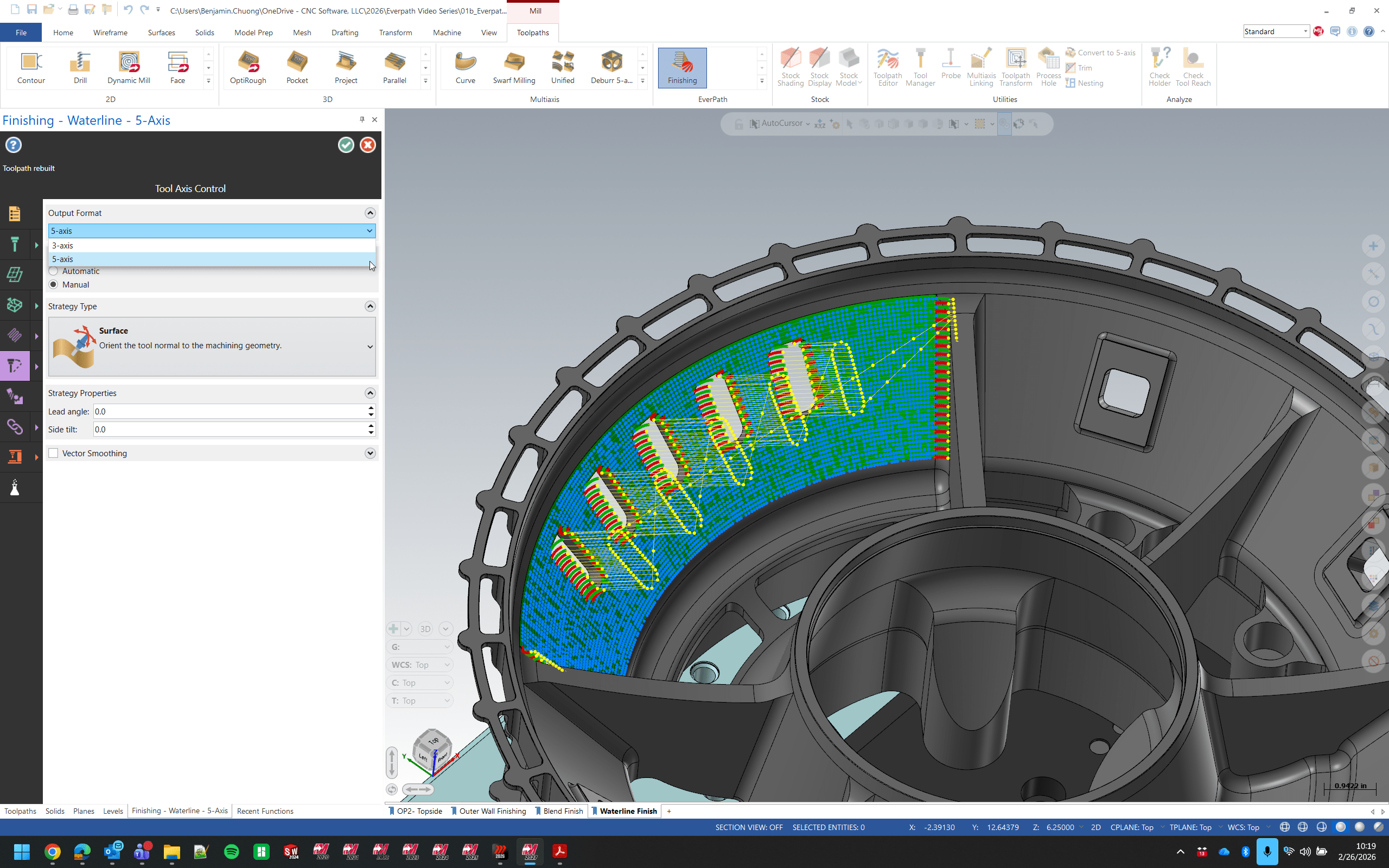
You build the toolpath the same way you always have: selecting geometry, defining tools, setting parameters. From there, the difference between 3‑axis and 5‑axis is not a new workflow, but a setting.
That consistency matters. It means you are not “switching modes” mentally or operationally. You are using the same Mastercam experience you already trust, with the flexibility to expand when the part demands it.
One Click to Explore Without the Risk
One of the most powerful aspects of EverPath Technology is also one of the simplest: the ability to switch between 3‑axis and 5‑axis strategies with a single click.
Instead of committing upfront to a multiaxis strategy, you can see it. Compare a traditional 3‑axis toolpath to a 5‑axis version. Evaluate tool engagement, motion, clearance, and surface finish. Then choose the approach that makes the most sense for the job in front of you.
There is no risk in trying it. No penalty for exploring. And no pressure to “get it right” the first time. This is multiaxis as an option, not an obligation.
Where This Makes a Real Difference
The value of seamless 3‑axis and 5‑axis switching shows up quickly in everyday programming scenarios.
- Avoiding collisions in deep pockets
Deep features often force compromises in 3‑axis (longer tools, reduced rigidity, slower feeds). With EverPath Technology, a subtle tool tilt can improve clearance and reduce the risk of collisions without rethinking the entire operation.
- Improving surface finish
Tilting the tool to maintain optimal contact can dramatically improve surface finish on complex geometry. Instead of accepting witness marks or secondary finishing operations, you can explore a 5‑axis strategy that delivers a cleaner result in the same workflow.
- Reaching difficult areas without refixturing
Some features are technically reachable in 3‑axis, but only with additional setups or fixtures. A controlled tool orientation can open access to those areas while keeping the part in place, saving time on the machine and on the shop floor.
In each case, EverPath Technology does not force a multiaxis solution. It simply makes it available when you need it.
Not About Turning Everyone into a 5‑Axis Expert
EverPath Technology is not designed to make every programmer a 5‑axis specialist overnight.
The goal is to remove the artificial divide between 3‑axis and multiaxis so you can use the right level of complexity for the job, without a steep learning curve or a disruptive change in process.
If a 3‑axis strategy is the best choice, you stay there. If a slight tool tilt improves the cut, you try it. If full 5‑axis motion solves a problem faster, it is available without starting over. Multiaxis becomes a spectrum, not a switch.
Same Workflow, More Capability
One of the most common barriers to multiaxis adoption is the perception that everything changes: how you think, how you program, how you validate.
EverPath Technology challenges that assumption.
The process of building a 5‑axis toolpath with EverPath Technology feels the same as building a 3‑axis one. Geometry selection, tool definition, and parameter control all follow a consistent pattern. The complexity is in the cut, not in the software.
That consistency lowers the learning curve and builds confidence. You are not learning “5‑axis programming”; you are extending skills you already have.
Lowering the Barrier to What is Possible
For many Mastercam users, the biggest unlock is not a new machine or a new tool, it is the freedom to explore better strategies without friction. EverPath Technology gives you that freedom.
By making every toolpath multiaxis‑ready, enabling single‑click exploration, and keeping the workflow consistent, EverPath Technology lowers the barrier to multiaxis in a way that feels practical, not intimidating.
You do not have to cross a line to use 5‑axis.
You just have to click.
Ready to Explore?
Access the EverPath Technology beta through myMastercam and start discovering what is possible when 3‑axis and 5‑axis work as one.