Bringing the Digital Thread to Life with the Mastercam Manufacturing Experience
Manufacturing rarely happens in a single system. Quoting, tooling, programming, simulation, machining, and inspection often rely on multiple software platforms, creating handoffs that can slow production and introduce risk.
During our latest webinar, Chad Chmura, Global Manager of Manufacturing Services at Mastercam, showcased how the new Mastercam Manufacturing Experience (MME) demonstrates a more connected approach. Using a real-world “nozzle mold” project, the team built a complete workflow that links every stage of the manufacturing process into a seamless digital thread.
The Challenge: Eliminating Gaps Between Manufacturing Systems
At the heart of the Mastercam Manufacturing Experience is a simple question: What if the gaps between your manufacturing systems disappeared?
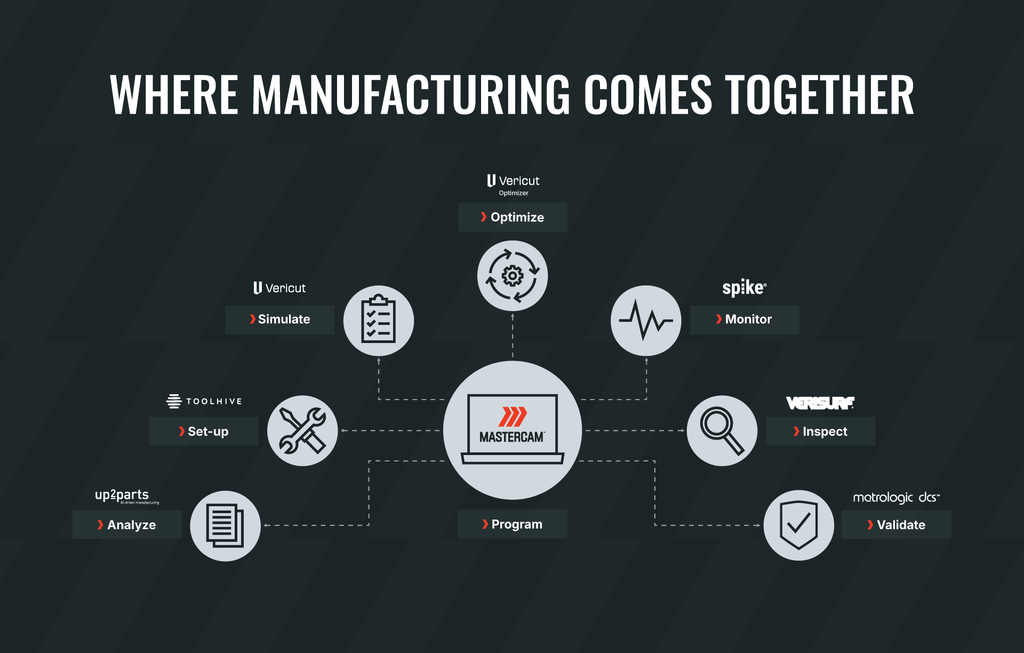
To answer that, Mastercam collaborated with several technologies within the Sandvik ecosystem to create an end-to-end workflow. Rather than focusing solely on CAM programming, the project highlighted how connected digital tools can streamline the entire manufacturing journey, from customer quote to final inspection.
The team selected a complex stainless steel nozzle mold that pushed the limits of their Haas UMC-500 machining center. The project served as a realistic demonstration of the challenges manufacturers face every day, including quoting, tool selection, programming, simulation, process monitoring, and quality validation.
Step 1: Faster Quoting with AI-Powered Part Analysis
The journey began with up2parts, which analyzed the CAD model and blueprint to automatically identify features, associate tolerances, assess manufacturability, and generate cost estimates. The software also created an initial manufacturing strategy, including suggested operations, tooling, feeds, and speeds.
One of the biggest advantages? Programmers can stay focused on programming while quoting responsibilities shift to less technical personnel. Manufacturers gain faster response times, more accurate estimates, and a validated starting point before CAM programming even begins.
Step 2: Connecting Manufacturing to Real Tool Data
Next, the team turned to Toolhive, a cloud-based tooling platform that provides access to verified manufacturer’s tooling data. Rather than manually building tool assemblies and maintaining multiple tool libraries, programmers can import complete tool assemblies directly into Mastercam.
For the nozzle mold project, Mastercam imported tooling and holder data directly from Sandvik Coromant, ensuring that the digital programming environment accurately reflected the tooling available on the shop floor.
Step 3: Programming Smarter with Mastercam
As the central hub of the workflow, Mastercam transformed manufacturing data into a complete machining strategy. Several technologies played a key role:
- Dynamic Motion® accelerated material removal while maintaining efficient tool engagement.
- EverPath Technology enabled faster refinement of complex finishing toolpaths with immediate visual feedback.
- Mastercam Copilot provided in-workflow assistance through natural language interactions.
- Cutting Parameters Agent delivered recommended feeds and speeds based on Sandvik Coromant tooling data.
- Deburr Toolpath automated edge finishing to improve consistency and reduce manual programming effort.
According to Chmura, the nozzle mold became an ideal showcase for EverPath Technology, demonstrating how quickly programmers can iterate and optimize complex machining strategies.
Step 4: Validating Programs Before They Reach the Machine
Before machining could begin, the NC code moved into Vericut for simulation and verification. Using a digital twin of the machine, Vericut simulated the complete machining process, checking for collisions, gouges, excess stock, and other potential issues.
The integration between Mastercam and Vericut allowed programmers to quickly identify issues, make corrections, repost code, and validate the changes before any material was cut. This helped improve confidence, reduce prove-out time, and minimize costly shop-floor surprises.
Step 5: Optimizing Performance, Not Just Safety
Using Vericut Optimizer, the team analyzed cutting forces, tool engagement, machine capabilities, and chip load throughout each toolpath. Feedrates were automatically adjusted to increase efficiency in lighter-cutting areas while protecting tools during heavier engagement.
The result was a more balanced machining process that reduced cycle times, improved tool life, and removed much of the guesswork traditionally associated with feed-rate optimization.
Step 6: Bringing Real-Time Intelligence to the Machine
Digital models are powerful, but real-world machining conditions can still vary.
That is where Spike Smart Tools came into the workflow. Using sensor-integrated tooling, Spike monitored actual cutting forces at the spindle during machining and compared real-world performance to expected cutting conditions.
This real-time feedback enables manufacturers to detect issues such as unexpected tool wear, process instability, or abnormal cutting conditions before they impact part quality. The technology also introduces the concept of predictive quality, helping manufacturers anticipate potential problems before they become costly defects.
Step 7: Verifying Quality Before Finishing Operations
Before committing significant machine time to final finishing operations, the team used Verisurf for in-process inspection. A Master3DGage portable arm and laser scanner captured thousands of data points and compared them directly to the CAD model.
This allowed operators to verify stock conditions, identify deviations early, and ensure the part remained on track before investing additional machining time. Because Verisurf runs on the Mastercam platform, the inspection process extends the digital thread while maintaining a familiar user experience.
Step 8: Closing the Digital Thread with Final Inspection
The final stage of the workflow used Metrologic Group’s Silma and Metrolog X4 platforms for comprehensive quality validation. Inspection routines were built from CAD data and tolerance requirements, then executed using a digital twin of the inspection environment.
The software generated detailed reports with pass/fail results, tolerance evaluations, and full traceability, providing documented proof that the finished nozzle mold met design intent and was ready for delivery.
Three Big Takeaways for Manufacturers
While each solution brings value on its own, the webinar’s most important lesson was the power of connectivity.
The Mastercam Manufacturing Experience demonstrates how a connected workflow can help manufacturers become:
Faster
- Accelerate quoting with AI-driven part analysis.
- Reduce programming time through automation and intelligent tooling data.
- Optimize cycle times using data-driven feed-rate improvements.
Safer
- Validate programs with digital twins before machining.
- Detect collisions and machining risks before they reach the shop floor.
- Monitor actual machining conditions in real time.
Smarter
- Connect data across quoting, programming, machining, and inspection.
- Create a continuous digital thread throughout the manufacturing lifecycle.
- Use real-world data to improve future decisions and process performance.
The Future of Connected Manufacturing
The nozzle mold project was more than a technology demonstration. It offered a glimpse into a future where disconnected manufacturing systems work together as a unified ecosystem.
By linking quoting, tooling, CAM programming, simulation, optimization, process monitoring, and inspection, manufacturers gain greater visibility, improved efficiency, and increased confidence from start to finish.
As manufacturing continues to evolve, the organizations that can successfully connect their data, processes, and people will be best positioned to compete.
The Mastercam Manufacturing Experience shows what that future can look like today.
Join Our Next Live Webinar
The best way to stay connected with the latest Mastercam and industry insights is by joining us live. Each of our webinars offer practical tips, guidance, and opportunities to engage with the people behind the technology you use every day. Be sure to visit our Events Page and register today so you can be part of our next live webinar.