Le programme d’usinage de San Diego ouvre la voie à l’emploi et place le San Diego City College sur le devant de la scène
The Machine Technology Program at San Diego City College is known for its strong curriculum that prepares its students for life on the shop floor. Students take a series of 11 classes leading to an Associates of Science Degree in Machine Technology, and several certificates of achievement – including Performance, CNC Technology, Computer Aided Manufacturing, CNC Operator, Computer Numerical Control Technology, and Machine Technology – unless they are already machinists who are there for training in the latest technology.
En bref
- Produit utilisé : Education Suite, Demo/HLE
- Industrie : Éducation
Détails du projet
- The Challenge: The Machine Technology Program (MACT) at San Diego City College has been teaching manufacturing technology since the early 1900s. Throughout the years instructors have had to keep up with changing technology in order to ensure that their students graduate with the skills and practical experience to work in the real world. In the 21st century, the challenge is no different.
- The Solution: Educational Suite, Demo/HLE, Dynamic Motion
- Avantages :
- Les formateurs peuvent enseigner aux étudiants à la fois les parcours d’outils hérités et les parcours d’outils dynamiques afin qu’ils soient préparés à tout type de scénario de programmation.
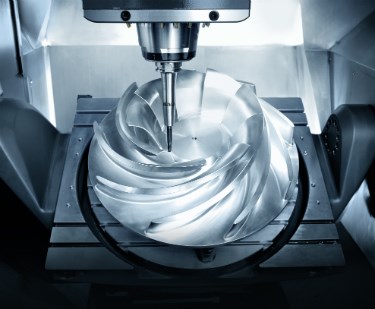
- La technologie du fraisage dynamique permet aux étudiants d’apprendre des techniques de coupe plus efficaces afin d’économiser du temps et des coûts de fabrication.
- La Mastercam Learning Edition permet aux étudiants de travailler sur des projets à la maison, de les mettre à jour à l’école et de terminer leurs travaux en moins de temps.
- Le logiciel est utilisé dans la plupart des usines de la Californie du Sud, de sorte que les étudiants maîtrisent le logiciel CAO/FAO standard de l’industrie, qu’ils soient novices ou vétérans en la matière.
Jack Bollinger, Professor of Machine Technology in the Engineering Department of San Diego City College, brings practical experience to his students, having worked in machine shops since the early 1980s. He and his team have created a curriculum that is considered a national model for machining education by the U.S. Department of Education and the National Science Foundation, both of which asked him to develop a sensible curriculum that could be disseminated across North America in a way everyone could understand. Bollinger sent his ideas regarding the CAD/CAM and CNC machining portions to them for distribution to roughly 600 different companies to critique. “It allowed us to get a rounded idea of what these companies wanted,” said Bollinger.
M. Bollinger se félicite de l’apport des sociétés du conseil consultatif du collège, dont certaines sont dirigées par ses anciens étudiants. Ses six professeurs adjoints et ses quatre assistants d’enseignement travaillent également dans l’industrie et lui font savoir s’ils doivent se concentrer davantage sur une compétence particulière ou même si une technique est en train de devenir obsolète.
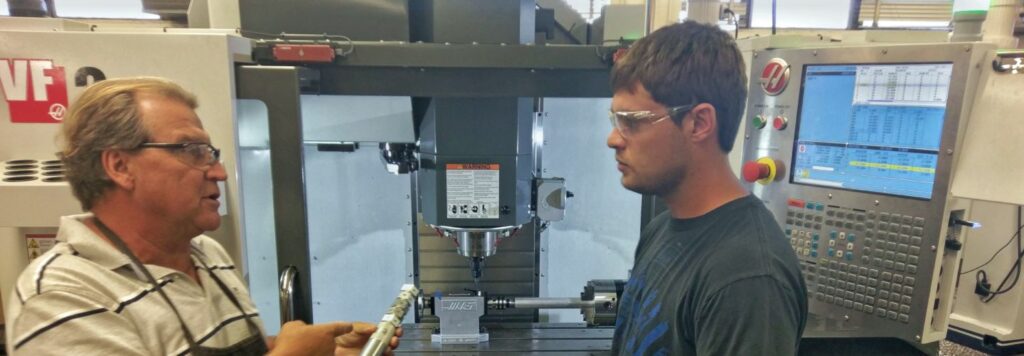
City College has almost 9,000 square feet of shop space with seven CNC milling machines, several manual machines, and three 3D printers as well as two computer labs. Students don’t move into the computer lab until the first two courses are completed. The Basic Principles/Machine Tech class uses the manual machines to teach the principles of milling operations while Intro to CNC and EDM, teaches students how to set up and operate CNC machine tools.
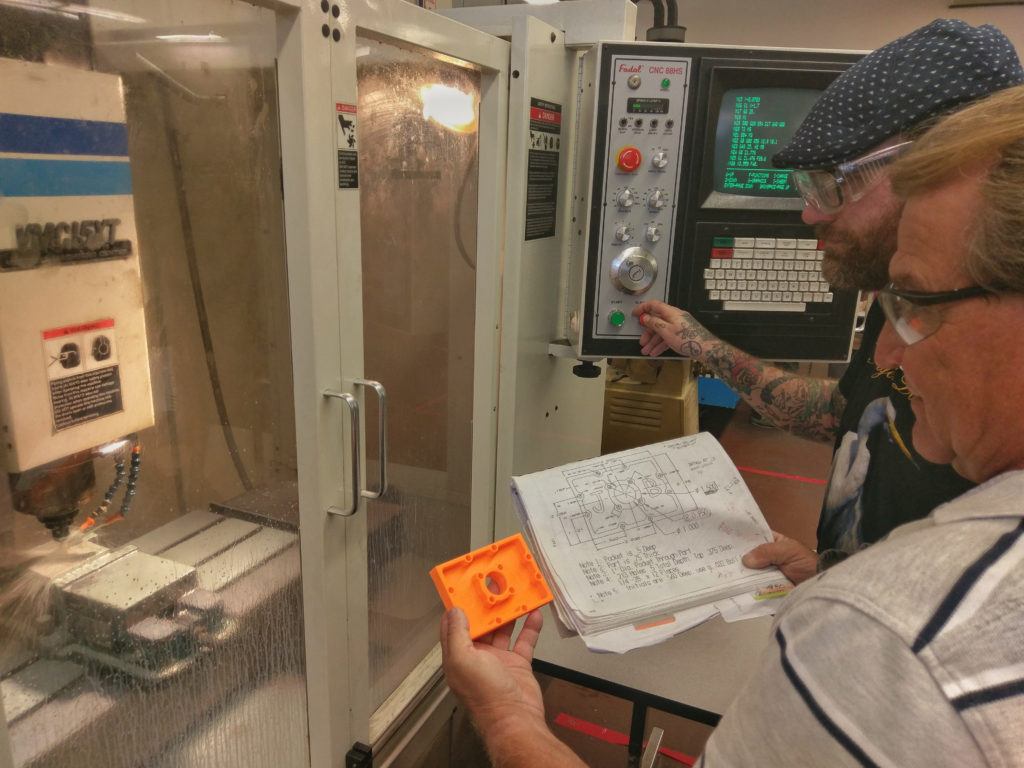
The Intro to CAD/CAM class takes the students into the computer lab and introduces them to CAD/CAM programming using 80 seats of Mastercam® software. “The students are basically using Mastercam to generate code,” said Bollinger, “but the curriculum also gets into contours, pockets, hole drilling, tapping and reaming, along with all the associated working files that go with those operations.” The introductory class teaches the types of CAD/CAM work students will find in actual job shops. Students then attend lab classes with extended lab hours which include videos for each of the projects, all of which are found on Bollinger’s web page. “Following this,” said Bollinger, “we go deeper into machining. Their first project or two utilizes hand coding and we teach them to use macros and loops and how to integrate their CAD/CAM programs into a project. And then we introduce them to 4-axis programming, as well as Mastercam’s Dynamic Milling to achieve faster, more efficient metal cutting operations. By teaching them both regular tool paths and Dynamic tool paths, we’re making them more marketable when they leave us. As they proceed, the work is progressively harder, and they receive less help from the staff in order to make them more self-reliant.”
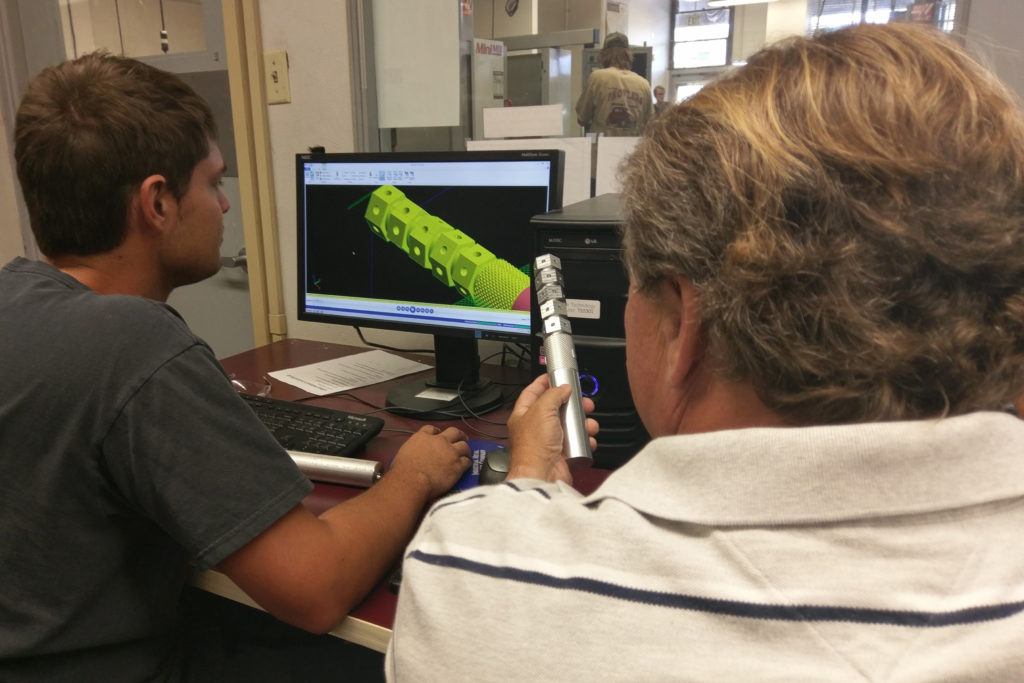
Les élèves apprennent également à faire des ajustements. Les instructeurs enseignent comment calculer les avances et les vitesses en donnant aux étudiants les paramètres, mais ils ne leur disent pas quelles vitesses et quelles avances utiliser. « Nous leur apprenons à le faire et leur donnons des exemples, mais c’est à eux de trouver la solution », explique M. Bollinger. Les étudiants reçoivent la Mastercam Learning Edition de démonstration et d’apprentissage à domicile. Ils peuvent travailler sur leurs projections à la maison, les mettre à jour à l’école, puis terminer leurs projets.
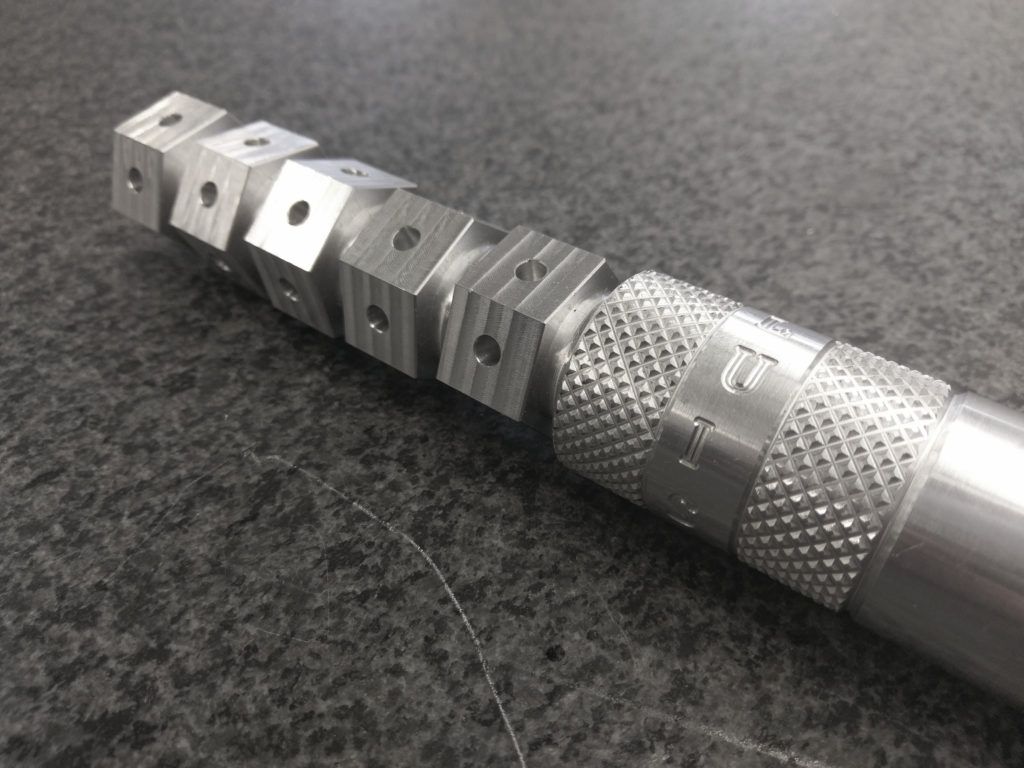
Le cours Mastercam avancé enseigne les parcours d’outils pour les surfaces et la modélisation solide. Ils apprennent également l’impression 3D en sélectionnant leurs parcours d’outils et en découpant la pièce dans Mastercam en tant que modèle solide. Grâce à un processus de vérification, le programme est sauvegardé sous forme de fichier .STL et chargé dans l’une des imprimantes 3D. Cette opération de prototypage rapide permet aux étudiants de voir, en plastique, à quoi ressemblera la pièce lorsqu’elle sera usinée en métal sur l’une des fraiseuses CNC.
Les instructeurs conçoivent des projets comportant des trous percés et des trous alésés, des taraudages, des poches et des contournages, et à peu près tout ce qui peut être programmé dans Mastercam et usiné sur une fraiseuse à commande numérique. « Nous continuons à utiliser Mastercam parce que c’est ce que l’industrie utilise. Lorsque nos étudiants apprendront à réaliser les projets prévus dans notre programme, ils seront en mesure d’effectuer les mêmes opérations sur n’importe quel projet du monde réel », a déclaré M. Bollinger.
Remarque : le programme MACT est soutenu par le Center for Applied Competitive Technologies (CACT), un programme qui relève du California Community College’s Chancellor’s Office Economic and Workforce Development (EWD) Program. Le CACT du San Diego City College propose plus particulièrement une éducation technologique, une formation à la fabrication et des services de conseil par le biais d’ateliers, de cours et de financements destinés à soutenir les efforts déployés pour que le programme reste innovant et compétitif.