L’atelier d’usinage élimine la marche de programmation avec Mastercam
Situé à Saukville, dans le Wisconsin, Oldenburg Metal Tech Inc. est spécialisé dans les matrices d’emboutissage complexes et progressives. L’atelier d’usinage de 25 000 pieds carrés produit également des montages de soudage, des pièces de production et des prototypes pour toutes sortes de produits, depuis les supports de direction automobile et les composants de châssis jusqu’aux plateaux dentaires. Les volumes peuvent atteindre des centaines de pièces pour les matrices d’emboutissage et les plaques de production, ou des milliers pour les petites pièces de production.
Les matrices d’emboutissage présentent des géométries complexes avec des tolérances serrées qui peuvent prendre du temps à produire en raison de changements d’outils, de ruptures ou de difficultés de programmation. Afin de réduire les délais et les coûts, Oldenburg a investi dans dix centres d’usinage verticaux, quatre centres de tournage – dont un avec des frais en tournage dédiés à l’usinage de production – et un puissant logiciel de CAO/FAO pour rendre la programmation plus facile, plus efficace et plus fonctionnelle.
En bref
- Product Used: Mill, Dynamic Motion
- Industry: Tool and Die, Automotive,Medical, Job Shop

Détails du projet
- Le défi : Fabriquer des matrices d’emboutissage progressif avec des géométries complexes et des tolérances serrées en moins de temps, sans changement d’outillage et sans casse lors des processus de fraisage dur.
- La solution : Mastercam, le logiciel de commande numérique le plus utilisé pour les opérations de CAO/FAO.
- Avantages :
- Mastercam est facile à apprendre.
- La technologie Dynamic Motion permet aux machines de fonctionner aussi rapidement que possible.
- Le fraisage dur pour des tolérances plus étroites est possible grâce à la disponibilité de différents types de parcours d’outils à grande vitesse.
- Les contrôles de collision permettent aux programmeurs de déterminer quand il est nécessaire de changer d’outil et de prévisualiser les finitions des pièces.
- La fonction Model Prep permet aux programmeurs de modifier les surfaces sans avoir à créer un modèle solide distinct.
According to CNC programmer Vinny Decker, most of the jobs that come through Oldenburg Tech have complex geometries with tolerances within 0.001” to 0.002” but can go within tenths of an inch when necessary. “We do so much hard milling here, that with some of the tighter tolerance or 3D work, the stamping box will be heat-treated, and I’ll need to perform a secondary hard mill operation to achieve certain tolerances, finishes, etc.” Decker relies on the different functions of Mastercam to get those tolerances and finishes while removing material at record rates.
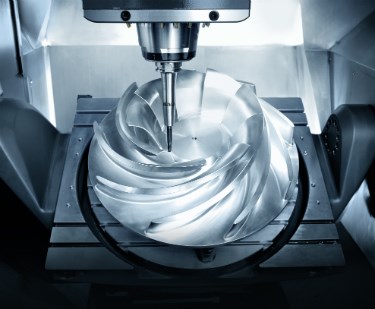
One key aspect is Dynamic Motion Technology which allows the shop to push the machines to their speed limits. Through proprietary algorithms programmed into the software, the tool remains constantly engaged with the material, automatically sensing changes in geometries programmed into the highspeed toolpaths by Decker. They do a lot of highspeed area roughing with highspeed mills. The waterline and raster finishing paths are done with carbide end mills and saw mills. Dynamic milling is also used for deep pockets with the machines removing material at a rate of 150” to 200” per minute. Typical end mill and ball mill sizes range from 1/8” to ¾” while the highspeed ball mills for roughing range from ½” to 2”.

The toolpaths have allowed Oldenburg to take on bigger and more complex jobs such as larger dies requiring 3D contouring and hard milling for tighter tolerances. The number of toolpaths available has allowed them to cut machining times in half.

Mastercam’s Verify feature provides Decker and the machinists the confidence to run the machines at high speeds without worrying about tool and part breakage, or damage to the machine. He “collision checks” parts where there might be some deep pockets or 3D contouring and uses Verify’s compare function to ensure that he didn’t accidentally hit something in the toolpath. The Accurate Zoom feature allows Decker to get an idea as to what the finish will look like.

Decker’s favorite software features are found in the Model Prep function because they are simple to use and save him a lot of time. “A couple of years ago, I might not have been able to close up a surface or fill in holes on a 3D surface,” he recalled. “At that time, I would have to go to our designers and ask them to create a separate model without the holes in order to run 3D paths on it.”
Decker said that 99 percent of the time he can suppress any feature on the solid model he chooses. He can extend 3D surfaces, move them up and down to add more clearance, or add more stock if necessary. By eliminating the need to create a separate surface model, he saves anywhere from five seconds to an hour in programming time.
Oldenburg recently machined 16 large, complex 3D stamping blocks measuring roughly 24” x 16” and 4” to 5” thick. The top of the blocks featured 3D contours in small radiuses. The surfaces were roughed, heat treated, and hardened to 60 Rockwell then hard milled. The total process took about 20 hours per block, including figuring out which of the many toolpaths available would work best and the different cutter technology for hard milling. Decker had to account for the finishing process, so he took all of the 3D surfaces and projected them up to about 0.0020” to reflect the extra stock needed.
Decker has always used Mastercam software and relies on his local Reseller, ShopWare, Inc. for support when questions arise and to train machinists in the software’s milling functions. He also explores the CAD/CAM capabilities of the software during lull periods, to discover additional functions and features that will make his work life easier. “It pays to invest a little of your time in learning the features because it’s going to save you a lot of time down the road.”
Devis client
« La meilleure partie du logiciel pour moi est certainement la feature de préparation de modèle. Le simple fait d’ajouter ces fonctions de préparation de modèle dans Bases de Mastercam a pratiquement éliminé une étape de mon processus, car je n’ai plus besoin de nouveaux designs pour supprimer ou modifier des caractéristiques sur un modèle 3D. »
– Vinny Decker, programmeur CNC, Oldenburg Metal Tech, Inc.
« Les gens de ShopWare viennent nous voir pour voir si nous avons des questions ou des préoccupations concernant des choses pour lesquelles nous avons besoin d’aide. Nous avons envoyé des personnes à ShopWare pour une formation de base sur les fraiseuses, pour apprendre à se servir de Bases de Mastercam à un niveau élémentaire. Ils sont également venus ici et ont suivi une petite formation en interne. Ils nous soutiennent beaucoup et sont là pour répondre à nos questions lorsque nous en avons.
– Vinny Decker, programmeur CNC, Oldenburg Metal Tech, Inc.