Associer la fabrication additive et soustractive pour un projet « inédit » – Dimensional Innovations crée la plus haute structure autoportante imprimée en 3D du monde
When presented with a unique task – create a nine-story memorial with strict safety and design expectations – Dimensional Innovations decided to combine the powerful techniques of additive and subtractive machining. Mastercam CAD/CAM software directed the 1020 Thermwood Large Scale Additive Manufacturing twin gantry machine that succeeded in producing the memorial.
En bref :
- Product Used: Mastercam Mill, Multiaxis
- Industrie : Signalisation personnalisée, monuments commémoratifs et « espaces construits basés sur l’expérience ».

Détails du projet
- The Challenge: The Al Davis Memorial had strict manufacturing parameters to which to adhere. It had to be nine stories tall, weigh under 250,000 pounds, withstand heavy winds, have highly reflective surfaces, be fireproof, and stay within the budget and timeline. Using only 3D printing to create such a structure would be impossible, given the high expectations for surface finishes and timeline expectations.
- La solution : Mastercam, le logiciel de CAO/FAO le plus utilisé pour les applications d’usinage.
- Avantages :
- Peut fonctionner avec presque toutes les unités d’usinage du marché, et les ingénieurs d’application sont disponibles pour aider à développer des codes.
- Les fonctionnalités étendues de CAO facilitent et accélèrent le Design, le tout dans la même interface que la partie FAO.
- Le fraisage 3 axes et 5 axes peut être géré dans la même interface.
- Les parcours d’outils multiaxes avancés facilitent la programmation sur cinq axes ou plus.
- La bibliothèque d’outils de Mastercam peut importer des informations sur les outils directement à partir des fabricants d’outils.
- La vérification et la simulation complètes sont possibles sans module additionnel coûteux.
Dimensional Innovations is a leading design and production firm, specializing in providing engaging experiences within a built space for entertainment giants and Fortune 500 companies. Because of their expertise in doing the impossible, they were chosen by the Las Vegas Raiders organization to create a nine-story memorial for the late Al Davis, former owner of the team. The sheer size of the nine-story-tall memorial made manufacturing daunting for the vast majority of shops in the United States. Add in the strict parameters set by the Raiders organization and Manica Architecture, the firm responsible for building the new stadium, and the project became next to impossible. The memorial had to weigh under 250,000 pounds, be able to withstand heavy wind load, provide an exceptional reflective surface similar to Anish Kapoor’s Cloud Gate in Chicago, adhere to exacting safety standards like being fireproof, and stay true to the initial design – and it had a firm budget and timeline
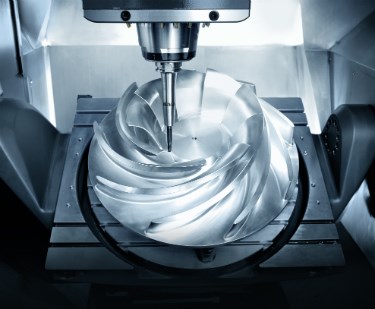
DI’s solution was to 3D print the memorial and then use 5-axis machining to finish the parts, which would allow them to achieve incredibly tight tolerances. The company purchased a 1020 Thermwood Large Scale Additive Manufacturing (LSAM) twin gantry machine specifically to make the memorial. The unit hosts a printhead on one side and a 5-axis router head on the other.
The first step after the design and manufacturing plan were finalized was building the 3D-printed structure of the torch. The LSAM ran 24/7 to produce 226 blocks, each weighing about 350 pounds, and 5,580 printed layers. After being printed, each piece was machined on the 5-axis router side of the machine to a tolerance of .005”. Chris Lanio, CNC programmer at Dimensional Innovations said, “With the LSAM, we could print a part, position the curtain over, and the next day machine it in that exact spot.” No unwieldy work-handling, no extra human hours; just efficient manufacturing.

Lanio poursuit : « La structure de base de la tour est essentiellement un sablier, presque une forme elliptique. Il n’y a donc pas deux pièces identiques. » Chaque pièce mesure environ 1,5 mètre sur 1,5 mètre, et l’épaisseur de la base est de 2,5 cm. Toutes les pièces sont fabriquées à partir de polycarbonate auquel on a ajouté 20 % de carbone en poids comme agent de renforcement.
Lorsque DI a acheté sa LSAM, on lui a conseillé d’utiliser Mastercam pour la partie fabrication soustractive. Le fabricant de la machine a mis au point un module additionnel C-Hook pour programmer la partie imprimante de la machine, qui fonctionne parfaitement avec ce système CAO/FAO spécifique. Pour maintenir la continuité, DI a également fait passer ses programmeurs 3 axes à Mastercam. Heureusement, le logiciel a fini par rendre chaque étape de la découpe plus rapide et plus facile.
La plupart des pièces étaient suffisamment similaires pour qu’il soit plus judicieux de modifier les fichiers existants que de programmer chaque pièce à nouveau. Le logiciel CAO de Lanio a facilité les choses. « J’ai pu stocker des données éprouvées, les réintégrer et les appliquer à la géométrie. Cela m’a permis de gagner beaucoup de temps à long terme sur l’aspect de la programmation », a-t-il déclaré. Lors de l’édition des modèles dans la partie CAO du logiciel, Lanio s’est appuyé sur la fonction Axe A pour tracer rapidement la géométrie et ajouter des trous sous plusieurs angles.

A substantial amount of machining was done with traditional 3-axis milling as well, with operations like pocketing and slotting, which the multiaxis CAD/CAM system was fully capable of supporting. To keep everything organized, Lanio used the Planes function in his software. The Work Coordinate System within the software uses a 3D Cartesian coordinate system to locate parts in the workspace. The Planes function helps users determine view angles, draw geometries, and associate tool angles to materials within that coordinate system. “A lot of the parts had 30 or 40 facets on them. I created planes and then imported the toolpaths to apply to each. It was a pretty smooth transition that let us keep working at a good pace and get two parts per day off of the machine,” said Lanio.
The material itself was so abrasive that solid diamond inserts were needed for DI’s Sandvik tools to cut it. “We have tools that are really specific for this machine, so I have all of those tools modeled in my library and can import them in for different jobs,” said Lanio. Mastercam Tool Library enables the import of tool data from original tool manufacturers like Sandvik. Programmers can add their own notes on the best toolpaths and motions to pair these tools with, as well as how well they run on each machine. “It has great cutting strategies stored for these different insert headers.”
Une fois que tout a été conçu et codé pour l’usinage, Lanio a ensuite vérifié et revérifié son programme. « Il est utile de disposer d’un véritable système de simulation du Code G, car il me suffit alors de sortir ces fichiers d’outils et de pièces vers notre logiciel de vérification. » Le logiciel de simulation Vericut confère une force supplémentaire aux fonctions de vérification dans le système de Simulateur Mastercam. Le module additionnel de vérification confirme la précision du parcours d’outil et les mesures dimensionnelles, de sorte que ce qu’un programmeur voit à l’écran est exactement ce qui se déroulera sur la machine.

Créer des expériences remarquables qui racontent l’histoire d’une marque de manière authentique, efficace et unique est la passion de DI. Son équipe prend l’innovation au sérieux et n’a pas peur de transformer ce qui n’a jamais été fait auparavant en une nouvelle normalité.
Devis client
« J’ai pu stocker des données éprouvées, les reconduire et les appliquer à la géométrie. Cela m’a permis de gagner beaucoup de temps à long terme sur l’aspect de la programmation. Il est utile de disposer d’un véritable système de simulation en Code G, car je peux alors simplement transmettre ces fichiers d’outils et de pièces à notre logiciel de vérification. »
– Chris Lanio, programmeur CNC chez Dimensional Innovations